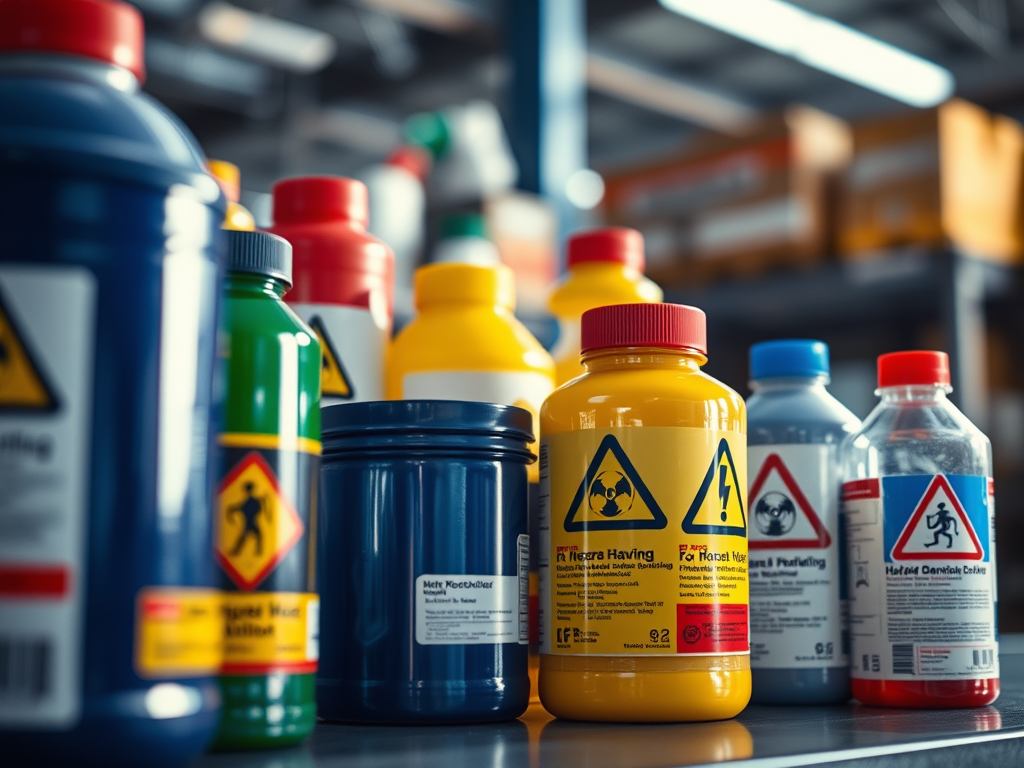
OSHA and NFPA stress that hazard labels must remain legible to keep workers protected.
Chemical labeling is one of the most visible elements of workplace safety programs. The Occupational Safety and Health Administration (OSHA) enforces the Hazard Communication Standard (HazCom), which incorporates the Globally Harmonized System of Classification and Labeling of Chemicals (GHS). Together, these frameworks require hazardous chemicals to carry standardized labels that convey critical information. Workers must be able to recognize and understand risks at a glance, whether in a laboratory, a construction site, or a manufacturing facility.
Hazard communication only works if labels remain intact. A label that fades or peels is no longer reliable. Durability is the factor that determines whether hazard communication functions as intended, or fails when workers need it most.
Put Labels at the Frontline of Safety
Safety data sheets contain extensive chemical information, but in daily practice, labels are often the first and only reference. A worker carrying a container will not stop to read 16 sections of documentation; they rely on the label to identify contents and precautions immediately.
Labels translate regulation into practical safeguards. Hazard statements, pictograms, and signal words appear in a uniform format that reflects both GHS principles and OSHA enforcement. If a label degrades, that uniform system collapses. Accuracy at the time of application is not enough, because durability is what ensures the information will last.
Make Durability Non-Negotiable
OSHA specifies the content required on labels, but leaves employers responsible for ensuring legibility over the life of the chemical. That expectation is routinely tested.
Containers are stacked in warehouses, transported outdoors, or exposed to solvents, heat, and disinfectants. Under these conditions, conventional labels often fail.
The National Fire Protection Association (NFPA), in its NFPA 704 “fire diamond” standard, highlights the potential consequences. In an emergency, first responders rely on clear hazard labels to make rapid decisions. If labels are unreadable, valuable time is wasted confirming contents, increasing risk for responders and surrounding communities.
When Labels Fail, Safety Fails
Label failure has consequences across compliance and safety. OSHA holds employers accountable for maintaining accessible, legible labels at all times. A damaged label is treated as noncompliant.
Common outcomes include:
- Improper personal protective equipment (PPE) use: Workers misjudge hazards when pictograms or signal words are unclear.
- Storage and transport errors: Secondary containers with legible identifiers may be mishandled.
- Emergency response delays: First responders lack critical guidance in containment or evacuation.
- Regulatory liability: Employers face citations or litigation when deteriorated labels contribute to incidents.
The National Institute for Occupational Safety and Health (NIOSH) estimates chemical exposures cause tens of thousands of workplace injuries each year. Inadequate hazard communication is often cited as a contributing factor. Durable labeling reduces these risks by keeping essential informaton intact under the very conditions that create danger.
Treat Durability as a Compliance Standard
Although HazCom does not dictate specific materials, OSHA’s requirement that labels remain “legible and available” makes durability an implied obligation. Employers must anticipate environmental and operational stressors, not simply apply labels once and assume compliance.
Predictable threats to label integrity include:
- Chemical exposure: Solvents, acids, and cleaning agents that dissolve ink or adhesives
- Environmental stress: Sunlight, humidity, and temperature extremes that cause fading and peeling.
- Physical abrasion: Containers scuffed or scraped through frequent handling and movement.
- Moisture and immersion: Condensation, splashes, or submersion that damage paper-based materials.
NFPA guidance reinforces the expectation that hazard identification must remain visible under such stressors. Failure to plan for durability exposes employers to both safety risks and citations.
Build Durability Into Every Label
Durability must be integrated into hazard communication programs.The following practices include:
- Select resistant materials: Use label stocks and adhesives designed for chemical resistance and UV stability
- Prioritize clarity: Print with high-contrast and fade-resistant inks.
- Conduct regular audits: Include label checks in scheduled inspections.
- Replace proactively: Keep compliant replacement labels readily available.
- Integrate training: Reinforce reporting of damaged or missing labels.
These steps make durability a deliberate strategy for compliance and worker protection.
Strengthen Safety Culture Though Durability
Durable HazCom labels may appear to be a technical detail, but are central to both compliance and culture. NFPA highlights the importance of visibility in emergencies, and NIOSH tracks the ongoing consequences of chemical exposures. Each organization points to the same conclusion: hazard communication only fulfills its purpose if labels remain intact.
A faded label signals more than wear—it reflects a breakdown in safety culture. By prioritizing durability, employers protect their workforce, uphold obligations, and ensure that hazard communication remains reliable in high-risk environments.
To Learn More
DuraLabel’s free GHS/HazCom Labeling Quick Start Guide gives you step-by-step instructions for creating compliant labels, improving safety, and meeting OSHA requirements. Download it at DuraLabel.com or call 1-888-342-3164 for expert guidance.
 Nicole Johnson
Leave a comment