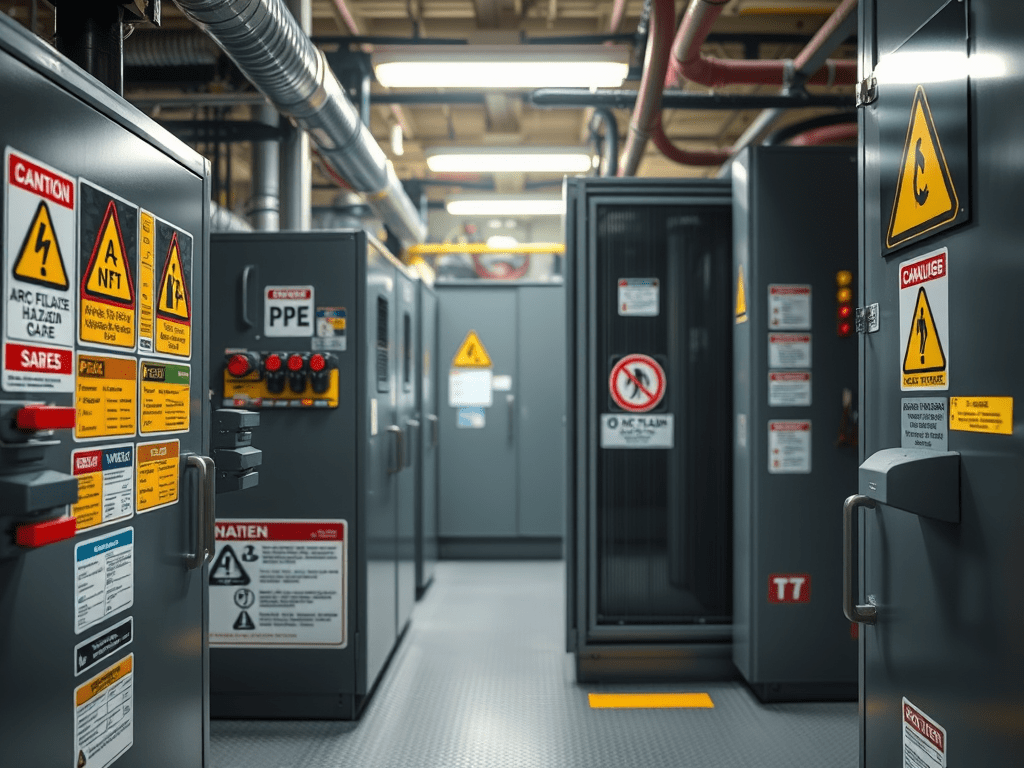
Cutting Arc Flash Hazards Before They Spark
Electrical hazards remain a major source of workplace fatalities and costly downtime. In 2022, 145 workers lost their lives to electrical exposure, according to the U.S. Bureau of Labor Statistics (BLS). [1] While engineering controls and personal protective equipment (PPE) often receive the most attention, visual communication through signs and labels is an equally critical safeguard.
In high-stress situations, such as arc flash incidents or equipment failures, the ability to identify systems at a glance can mean the difference between quick containment and severe injury. Clear, consistent labeling of electrical infrastructure enables emergency responders and maintenance teams to act decisively, protecting both workers and operations, and ensuring compliance with National Fire Protection Association (NFPA) and Occupational Safety and Health Administration (OSHA) standards.
Labeling as a Core Component of Visual Safety Systems
Electrical safety isn’t just about engineering controls. It’s about how clearly a system communicates risk. Visual systems such as hazard signs, equipment labels, and standardized color coding translate technical information into fast, actionable guidance.
In high-risk areas, such as high-voltage switchgear rooms, zones with arc flash potential above 8 cal/cm², or confined electrical vaults, labeling should go beyond panel directories to include:
- Arc flash hazard labels: Show calculated incident energy and approach boundaries
- PPE signage: Indicate exact gear required before entry or operation
- Voltage markers: Identify busways, terminal blocks, and power distribution units
- Reflective or photoluminescent signage: Ensure visibility during outages
- Lockout/tagout tags: Include technician ID, date, and work status
When applied consistently, these elements create a shared safety language across the facility that eliminates confusion, speeds response, and protects workers in both everyday maintenance and high-stakes emergencies.
How Labeling Supports Emergency Response
Once a visual safety system is established, its value is proven during incidents. Electrical events demand immediate containment to prevent escalation, and labels serve as the first line of communication.
Labels on disconnect switches, breaker panels, and live equipment provide essential details such as voltage, arc flash boundaries, and PPE requirements. These labels act as visual risk indicators, turning technical specifications into actionable guidance within seconds.
For facilities with multilingual crews or during outages with limited lighting, standardized ANSI-format labels with high-contrast colors help eliminate confusion. NFPA 70E specifies that arc flash labels must display:
- Nominal system voltage
- Arc flash boundary distance
- Required PPE category or incident energy level
Together, these elements create a shared visual language for anyone on site, whether it’s a licensed electrician or a first responder with no electrical training. That clarity is vital, especially since 70% of workplace electrical fatalities occur in non-electrical occupations, according to the Electrical Safety Foundation International (ESFI). [2]
How Circuit Breaker Labeling Supports Speed and Specificity in Critical Situations
Breaker panels are a central point of control during emergencies. Without precise labeling, isolating the correct circuit can force responders to trace wires under pressure, a process that wastes valuable time and increases the risk of costly mistakes.
The National Electrical Code (NEC) Article 408.4 requires panel directories to be legible, accurate, and permanently affixed, with clear descriptions that identify the exact equipment or area each breaker serves. Generic terms like “Lights” or “Outlets” are not sufficient for compliance. [3]
Where arc flash hazards are present, breaker panels should also carry NFPA 70E-compliant labels that specify the calculated incident energy and approach boundaries. This ensures that anyone opening the panel immediately understands the PPE requirements before exposure.
Conduit and Cable Labeling for Safer Maintenance
Unmarked conduit systems can delay maintenance, cause accidental energization, or lead to repairs being performed on the wrong circuit. These risks are especially high in older facilities where as-built drawings are outdated or incomplete.
Best practices for conduit ad cable labeling include:
- Consistent placement at junctions, bends, and termination points
- Color coding based on ANSI Z535.1 standards (e.g., orange for dangerous voltage)
- Use of materials that resist moisture, chemicals, and UV damage
- Date coding to indicate the last inspection or update
When conduit systems are clearly marked, technicians can more easily follow lockout/tagout procedures, trace connections, and reduce the risk of arc flash exposure caused by accidental contact with energized components.
Regulatory Expectations for Labeling Electrical Systems
Clear labeling isn’t optional. It’s a regulatory requirement. Both OSHA and the NEC define labeling as a core element of safe electrical system design and operation.
- OSHA 29 CFR 1910.303(e): Each disconnecting means must be legibly marked to indicate its purpose, and the marking must be durable enough to withstand environmental conditions.
- NEC Article 110.22: Disconnects and overcurrent devices must be labeled with permanent, clear information to prevent mistakes.
These standards exist to minimize confusion during servicing or emergency response. However, compliance is only the baseline. Labels that meet code may still fail in the field if they are not strategically placed, designed for visibility, and maintained over time.
To ensure they remain effective, facilities must trat labeling as an ongoing part of electrical system management. An effective system would be one that supports not only safety during incidents, but also efficiency in maintenance and long-term operations.
Long-Term Value of Electrical Labeling
Electrical labeling does more than prepare teams for emergencies. It also strengthens day-to-day operational continuity. A well-documented and consistently labeled system reduces troubleshooting time, simplifies system expansions, and preserves institutional knowledge even as personnel change.
Digital integration enhances labeling even further. Linking panel directories, arc flash studies, and equipment layouts to a central database gives maintenance teams real-time system details in the field. This reduces redundancy, prevents guesswork, and ensures that updates are captured for both compliance and safety.
Routine audits ensure labels remain accurate and legible. Replacing worn or outdated labels before they fail helps prevent errors, costly incidents, or compliance gaps.
Infrastructure Is Only as Safe as It Is Understood
Whether facing arc flash hazards or performing routine breaker resets, visibility is the foundation of electrical safety. Clear, durable, and standardized labeling ensures workers at every level have the information they need to act quickly and correctly. In a high-voltage environment, that can mean the difference between a minor incident and a life-threatening event.
By elevating labeling to a core safety system, facilities not only reduce risks and strengthen emergency response, and they also build the operational resilience needed to protect people and keep industry moving.
[2] Electrical Fatalities in the Workplace: 2011 – 2022 – Electrical Safety Foundation International
 Nicole Johnson
Leave a comment